


Visual perceptual difficulties – when do I need to take my child to an Occupational Therapist.
As a parent, you know your child’s strengths and weaknesses. But life puts so many expectations on our children, and it is natural to wonder if your child is coping with it all. Many parents will know that their child is bright, curious, and capable — yet certain everyday tasks seem unexpectedly difficult.
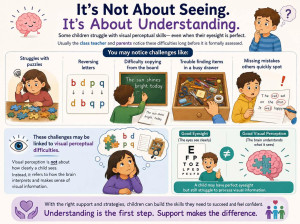
Your child may struggle with puzzles, reversing letters, copying from the board, finding items in a busy drawer, or noticing mistakes that others quickly spot. Usually the class teacher and parents note issues of this nature long before it is formally assessed.
These challenges may be linked to visual perceptual difficulties.
Visual perception is not about how clearly a child sees. Instead, it refers to how the brain interprets and makes sense of visual information. A child may have perfect eyesight but still struggle to process what they see effectively.
What Are Visual Perceptual Skills?
Visual perceptual skills help children understand, organise, and respond to visual information in their environment. These skills are essential for learning, play, independence, and participation at school.
Examples include:
- Recognising letters and numbers
- Not confusing similar looking letters and numbers
- Understanding which way around letters and numbers belong on a page or in a word or sentence.
- Identifying differences between shapes or images
- Completing puzzles
- Copying work from the board
- Remembering visual information
- Finding objects in cluttered spaces
- Understanding spatial relationships
- Reading and handwriting
Visual perceptual skills are closely linked to academic performance, handwriting, reading, and participation in daily activities. Issues here will affect how your child participates in class, does his / her homework, how well they enjoy sport and playing with friends, and how well they can take care of themself
Signs Your Child May Be Experiencing Visual Perceptual Difficulties
Every child develops differently, but some signs may indicate that extra support is needed.
Your child may:
- Reverse letters or numbers beyond the expected developmental age
- Lose their place while reading
- Struggle with puzzles or construction toys
- Have messy spacing in handwriting
- Frequently miss visual details
- Take a long time to complete visual tasks
- Become frustrated during schoolwork
- Have difficulty copying accurately
- Struggle to organise written work on a page
- Frequently lose belongings in visually busy environments
These difficulties can sometimes affect confidence, school participation, and emotional wellbeing.
When Should I Consider Occupational Therapy?
It may be helpful to consult an Occupational Therapist if these challenges:
- Interfere with school performance
- Cause frustration or avoidance
- Affect independence in daily activities
- Persist over time despite support
- Impact handwriting, reading, or play
- Lead to reduced confidence or anxiety around learning
An Occupational Therapist can assess how visual perceptual skills are affecting your child’s everyday functioning and participation.
Importantly, assessment looks beyond isolated skills. Occupational Therapists evaluate how visual processing influences meaningful daily occupations such as learning, self-care, play, and social participation.
What Happens During an OT Assessment?
Assessment is usually play-based and child-friendly.
The Occupational Therapist may assess:
- Visual discrimination
- Visual memory
- Visual spatial skills
- Eye-hand coordination
- Fine motor skills
- Gross motor skills
- Sensory profiles
- Attention and concentration
- Functional school tasks
- Handwriting and classroom participation
Therapists may also collaborate with teachers, optometrists, psychologists, and parents to gain a holistic understanding of the child’s needs.
Can Occupational Therapy Help?
Intervention approaches which are task-specific, meaningful, and integrated into functional activities tend to produce the best outcomes for children.
Occupational therapy intervention may include:
- Play-based visual perceptual activities
- Handwriting support
- Visual-motor integration activities
- Environmental adaptations
- School support strategies
- Cognitive and problem-solving approaches
- Parent education and home programmes
Research on paediatric occupational therapy interventions continues to grow, although many systematic reviews note that more large, rigorous randomised controlled trials are still needed in this field. (PubMed)
Early Support Matters
Children do not simply “grow out of” all visual perceptual challenges. Early identification and support can reduce frustration and help children develop confidence and participation in everyday activities.
If you are concerned about your child’s visual perceptual skills, seeking professional guidance early can provide clarity, support, and practical strategies.
Need Support?
At Broughton and Jonck we support children and families through evidence-informed, play-based occupational therapy interventions tailored to each child’s unique strengths and needs.
173 Underwood Road, Sarnia, Pinetown
Tel: 031 708 1785/8
Mobile: 0625431121
📩 Contact us to book an assessment or learn more.
References
- Hoy MM, Egan MY, Feder KP. A systematic review of interventions to improve handwriting. Canadian Journal of Occupational Therapy. 2011. (Sage Journals)
- Case-Smith J, Frolek Clark G, Schlabach TL. Systematic review of interventions used in occupational therapy to promote motor performance for children ages birth–5 years. American Journal of Occupational Therapy. 2013. (PubMed)
- Effectiveness of CO-OP Approach for Children With Neurodevelopmental Disorders: A Systematic Review. Archives of Rehabilitation Research and Clinical Translation. 2023. (ScienceDirect)
Published:
2nd Jun 2026